

Content decay can be a silent killer for organic performance, slowly eroding your gains and making it harder to maintain your growth rate in organic traffic and revenue. With the rise of AI Overviews, ChatGPT Search, Perplexity, and other LLM-powered search experiences in 2024 and 2025, content decay has taken on new dimensions beyond traditional ranking losses.
If left unchecked, it can eventually reach a point where your total organic traffic is declining, no matter how much new content you create. This sounds ominous, I know, but there's good news too. Once you understand what content decay is, how to identify it, and how to fix it, it can actually become a really exciting and effective part of your content strategy.
What is content decay?
Content decay is an ongoing decline in organic traffic, rankings, and/or leads for one or URLs on your website. The term "decay" specifically describes a slow, gradual decline rather than a sudden drop. This gradual pattern means decay can go unnoticed for long periods, resulting in compounding losses over time.
To better understand this, we can look at the stages of the content life cycle.
Stages of the content life cycle

When you have studied the performance of individual blog posts long enough, and at scale, a pattern emerges. A piece of content will often follow a similar life cycle that has a big impact on how your content performs, especially as you get to hundreds or even thousands of blog posts on your site.
Early Traction
When you publish new content on your site or blog, it will take some time for it to start to rank and drive organic traffic. There are a number of factors that play into how long that period lasts, but in general, it is common for performance to ramp up over time.
Newer content is indexed by the search engines and then the algorithms will get an initial understanding of how your blog post stacks up, fits search intent, and more. You may notice a few mini spikes in traffic here and there for the first week or two as the content is crawled and analyzed. From there, if it is optimized and competitive, it will begin to build some consistency and start to create some early traction.
If you have a solid audience built up on your social media channels and a good newsletter list, you may see a nice spike in total traffic, but that will not last long and then it is back to reality with the slowly building organic traffic.
Growth
The growth phase is fairly straightforward. As your content gains more backlinks and begins to rank higher and for more queries, the organic traffic to the post will continue to grow.
Again, every post and topic is different in terms of how fast the growth happens and for how long.
Peak
The peak stage is when the growth starts to taper off because of one of several reasons:
- The post stopped gaining backlinks and is no longer improving in the SERPs
- The post reached the top slot for nearly all of the keywords in the topic and has hit a natural ceiling that is limited by the total searches per month
- A competitor has published new content on the topic or updated their existing content
The peak stage is also very dynamic. For some URLs, it may only remain at the peak for days or weeks before moving into the decay stage, or it may plateau at the peak and stay that way for months. Not growing, but also not yet decaying.
Decay
As older content becomes less relevant, less fresh, and/or less competitive in the SERP, it will move out of the peak/plateau stage and begin to decay.
And as mentioned earlier, it may not necessarily be “old content” per se. If it is a competitive topic, the life cycle is shortened and it will typically reach the decay stage much sooner.
So now that you understand what content decay is and where it fits into the content life cycle, let’s dig in to the different causes of content decay.
What causes content decay?
One of the things that makes content decay challenging to prevent and/or fix is that it happens for a number of reasons. The most common causes for content decay that we see regularly are freshness, internal competition, external competition, a shift in search intent, and topical depth.
Content Age / Freshness
Search engine algorithms and LLMs prioritize fresh content.
Think about it. How often do you see results in the SERP that are from 2004?
There’s nothing inherently wrong with content that was originally published more than a decade ago, but the “freshness” of the content comes down to how well it has been updated to stay relevant and optimized to keep the content aligned with the intent of the keyword phrases searched.
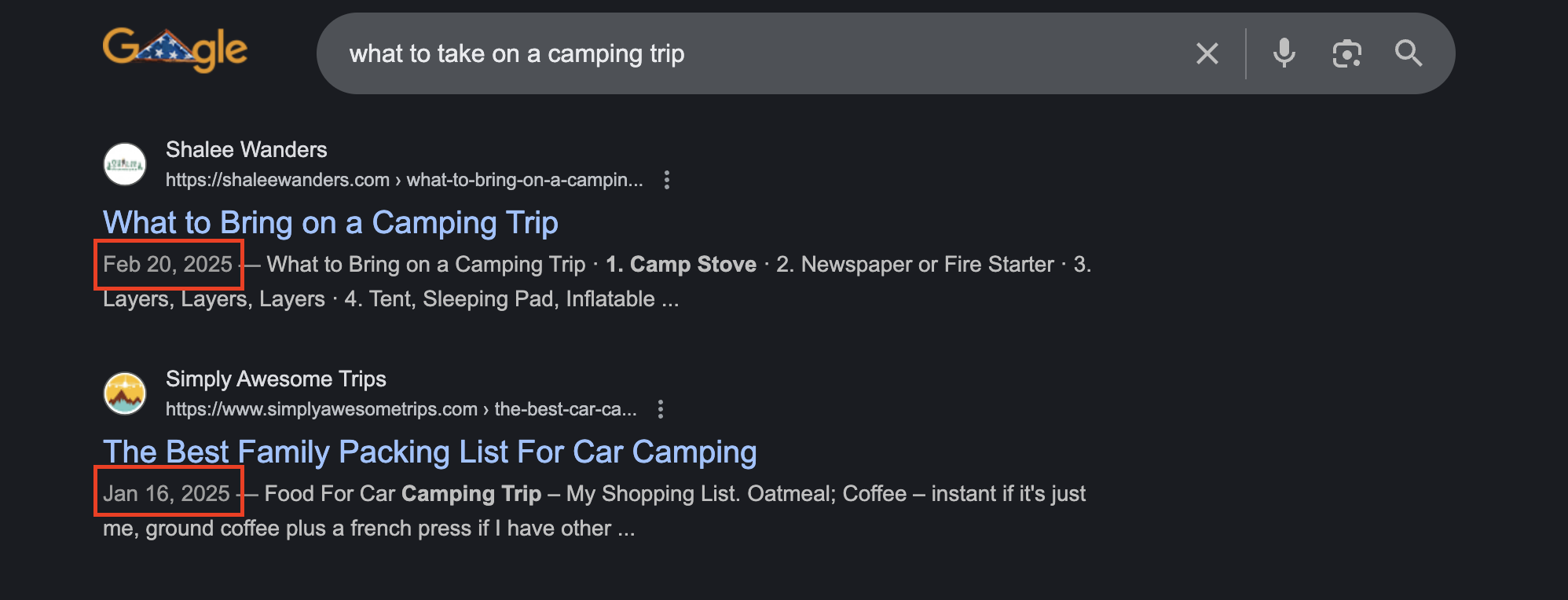
With SERPs that include videos from YouTube, those also tend to follow a very similar pattern of freshness. However, one area where you may see results from 4-8 years ago is Reddit/forums. This mostly has to do with the fact that the original thread was started then but has been added to more recently AND the entire thread is a goldmine of real advice from people over time.
In terms of AI Overviews and LLMs, the results tend to favor freshness even more aggressively, typically favoring content created or updated within the last 6 months.
Internal Competition
Internal competition refers to a situation where there are multiple URLs on your website that are all roughly covering the same topic and therefore, competing with one another for rankings.
This makes it harder for the search engines to determine the right URL to feature and leads to suppressed performance for all of the conflicting URLs.
This is also not limited to blog posts competing with other blog posts. In many cases, you will have blog posts competing with other blog posts, category pages, glossary pages, product/feature pages, and more.
Internal competition can be sneaky because it happens over time and is easier to go undetected than external competition.
External Competition
External competition is probably the cause of content decay that is most easily understood by marketers and non-marketers alike.
SEO is competitive and continues to get more competitive over time. With many different websites vying for rankings and traffic on the same topics, it is easy to see how you may lose ground to competitors. In 2025, competition extends beyond traditional search rankings to include being selected as source material for AI summaries and overviews, adding another layer of competition for visibility.
Many factors come into play when determining why competitor sites are causing your content performance to decay, but the main ones include their brand/authority, volume of backlinks to the URL, and how well they align with search intent. AI systems also prioritize these same signals when selecting authoritative sources to cite in generated answers.
Search Intent Shift
Search intent is a fancy way of saying ‘what the person searching was hoping to find by searching that keyword phrase’ and it is often evolving.
Google is constantly evaluating how users interact with the results served for any query as a signal to understand their intent. As the word changes, so does search intent.
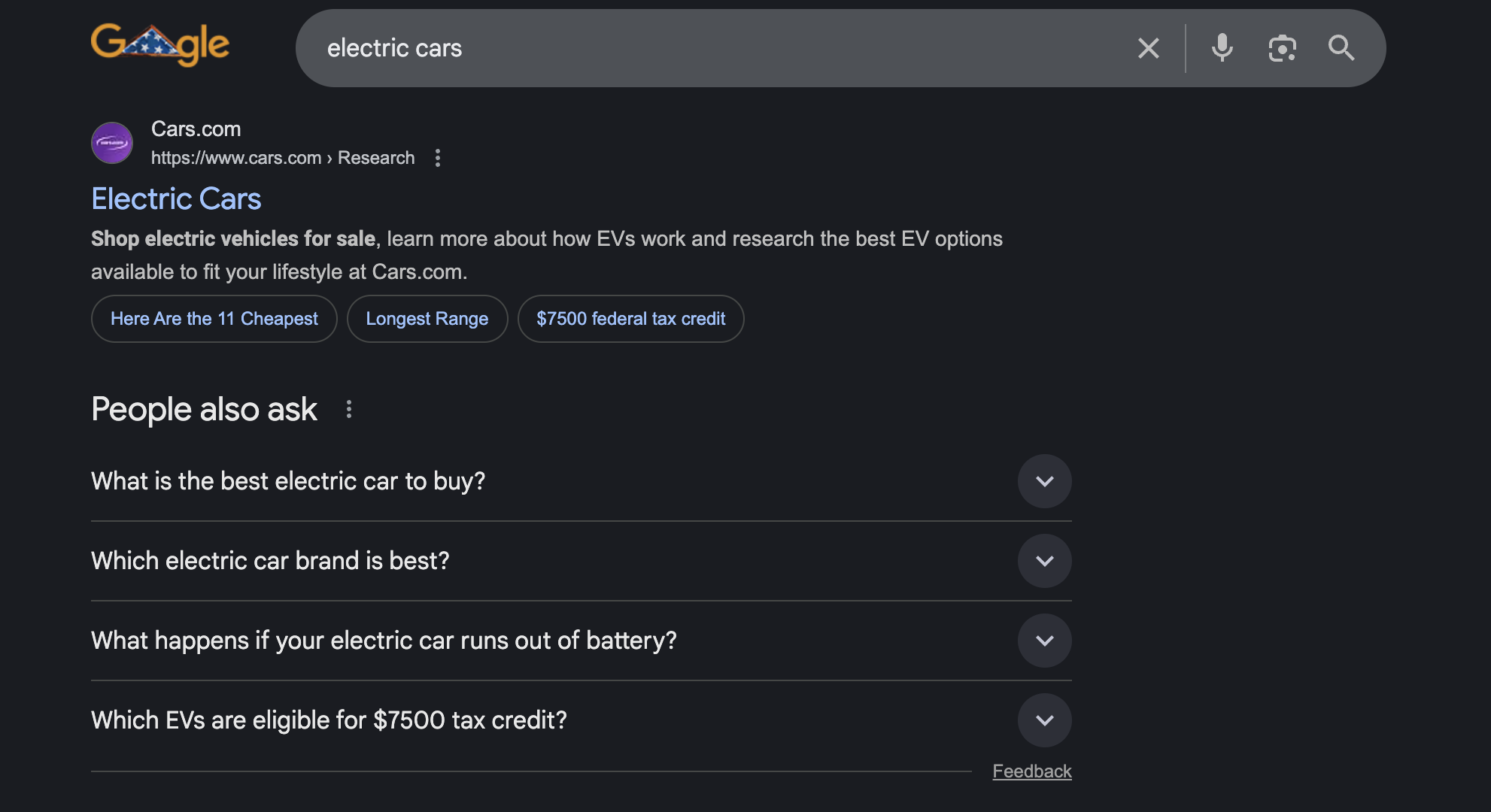
For example, someone searching ‘electric cars’ in 2000 was likely looking for information or educational research on what they are, how they work, etc. Now, 25 years later in 2025, someone typing in that same query is likely in the process of researching electric cars with the intent to buy.
Topical Depth
Similar to how search intent can shift, so can aspects of a particular topic. As a topic evolves, your content may slowly become less of an in-depth resource on the topic, causing the performance to decline.
AI Overviews & LLM Impact on Content Decay
The emergence of AI-powered search experiences has introduced an entirely new dimension to content decay that goes beyond traditional ranking fluctuations. With Google's AI Overviews, ChatGPT Search, Perplexity, and other LLM-powered answer engines now mediating how users find and consume information, content can experience "visibility decay" even while maintaining its position in traditional search rankings.
The AI Visibility Problem
Here's what makes this particularly challenging: your blog post might still rank #3 for your target keyword, but if it's not being cited as a source in the AI Overview that appears above all organic results, you're missing out on a significant portion of potential traffic. Studies from 2024 show that AI Overviews can reduce click-through rates to traditional organic results by 30-60% for queries where they appear.
This creates a new type of content decay where your metrics tell you everything is fine, but your actual traffic and visibility are silently eroding.
How AI Systems Determine Source Quality
LLMs and AI-powered search engines don't evaluate content the same way traditional search algorithms do. They prioritize:
Clarity and Structure - AI systems favor content with clear, declarative statements that can be easily extracted and cited. Vague or overly flowery language that works for human readers may be passed over by AI systems looking for definitive answers.
Explicit Claims with Evidence - Content that makes specific claims backed by data, research, or authoritative sources is more likely to be selected as a citation source. AI systems are looking for content they can confidently reference.
Recency Signals - While traditional search has always valued freshness, AI systems are even more sensitive to content age. Since many LLMs have knowledge cutoffs, and AI Overviews heavily favor recently updated content (often within the last 3-6 months), older content experiences accelerated decay in AI visibility.
Authority Markers - Author credentials, expert quotes, original research, and links to authoritative sources serve as trust signals that increase the likelihood of your content being selected as an AI Overview source.
How does content decay impact organic traffic/SEO/LLM visibility?
The most obvious place to focus on the impacts of content decay is organic traffic, but it isn’t just the traffic that suffers. The decaying content can and most likely will suffer a decline in search visibility, CTR drops, fewer business outcomes like leads or revenue, and fewer backlinks. Additionally, marketers now need to deal with the fact that decaying content impacts both SEO and LLM visibility, potentially impacting discoverability across multiple surfaces.
Decline in search & LLM visibility
As the content begins to decay, the number of keywords a post ranks for will decrease and your overall visibility will decline. Remember, blog posts don’t just rank for the target keyword, they most often rank for dozens, if not hundreds or thousands of keywords. Similarly, the number of queries in LLMs where you are mentioned or cited can also decline.
Click-through rate (CTR) drops
Many studies exist that have proven the highest ranking results in organic search get the highest click-through rate. As your content decay causes your blog post to start to fall in the SERPs, your click-through rate will ultimately decline, causing you to get less and less of the search traffic available.
Zero-click searches
Now, we can’t talk about decay and CTR without immediately discussing AI Overviews and the rise of zero-click searches that now happen across more than 50% of searches in Google.

From featured snippets and answer boxes to AI overviews, the top of the SERP has been rapidly evolving over the last several years, and this is definitely an important nuance to analyzing your content decay. In many cases, your content may be fresh and optimized and you are featured in the AI overview, but because the searcher no longer needs to click through to your site, you experience declines in CTR and clicks.
Site behavior decreases business outcomes
When your content is decaying, it typically means that it is no longer one of the best, most relevant results. That means that if those searching click on your result but don’t find what they want/need, they will leave without going deeper into your site, which makes it hard to get any sort of real business results from visitors who don’t stay on your site.
Poor backlink performance
As your content decays, it affects your ability to gain and retain backlinks. Whether from the content being outdated or not aligned with search intent, the quality of the content has declined, losing the appeal for people to link to your content organically. And in some cases, when your content is very out of date, you may lose backlinks as site owners remove the link to your content because it is now a poor experience to send their visitors to your content.
Schema & entity recognition
Weighing more heavily on the LLM side (but still relevant to SEO), it is critical to ensure that your content is properly structured and formatted for information extraction. Organization, products/services, FAQ, and article schema are all important to have set up correctly.
How to identify content decay
You may think that this should be easy. Just log into analytics and find the content that has lost the most traffic, which can happen, but it isn’t always so cut and dry and there is a lot of opportunity in the less obvious.
Every post is different and in some cases there may even been strong seasonality, so knowing where to look and what to look for will be critical in identifying content decay on your site.
Tools to use to identify decay
We typically recommend using at least 2 of the following 3 data sources to identify your decaying content since each one paints a slightly different picture.
Google Analytics
You can use Google Analytics to identify and analyze content decay because it can be contextualized with conversions. There are a number of different ways to pull the reports that include organic traffic & landing pages.
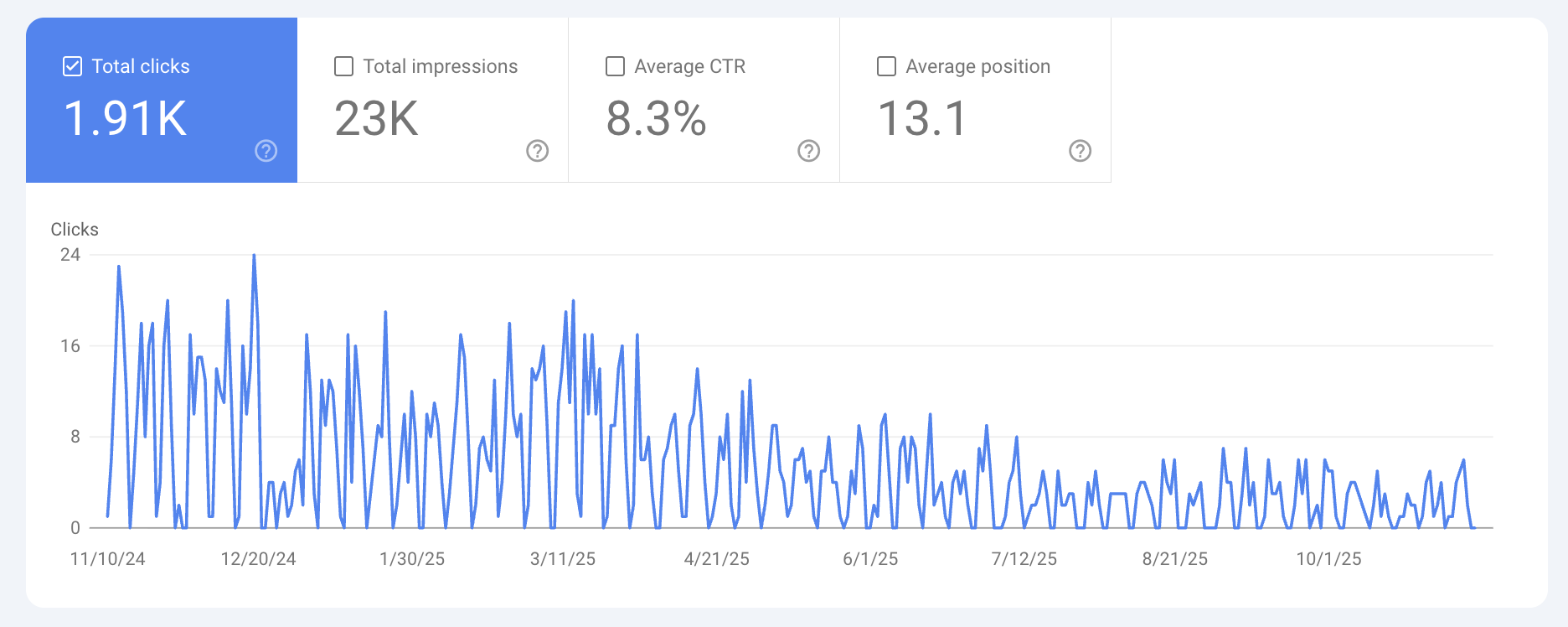
From there, you can look over a longer period of time to see the decline or compare two different date ranges to find the URLs with the greatest amount of decline in traffic.
Google Search Console
Search Console will provide you with the most robust data on organic search performance, allowing you to see performance by URL, but also going a level deeper to understand the queries matching to each URL and how each performs.
In Search Console, go to the Performance > Search Results, select a time range or select two date ranges to compare. From there, you can view both Queries and Pages data to find the URLs where decay has occurred.
Ahrefs/SEMrush
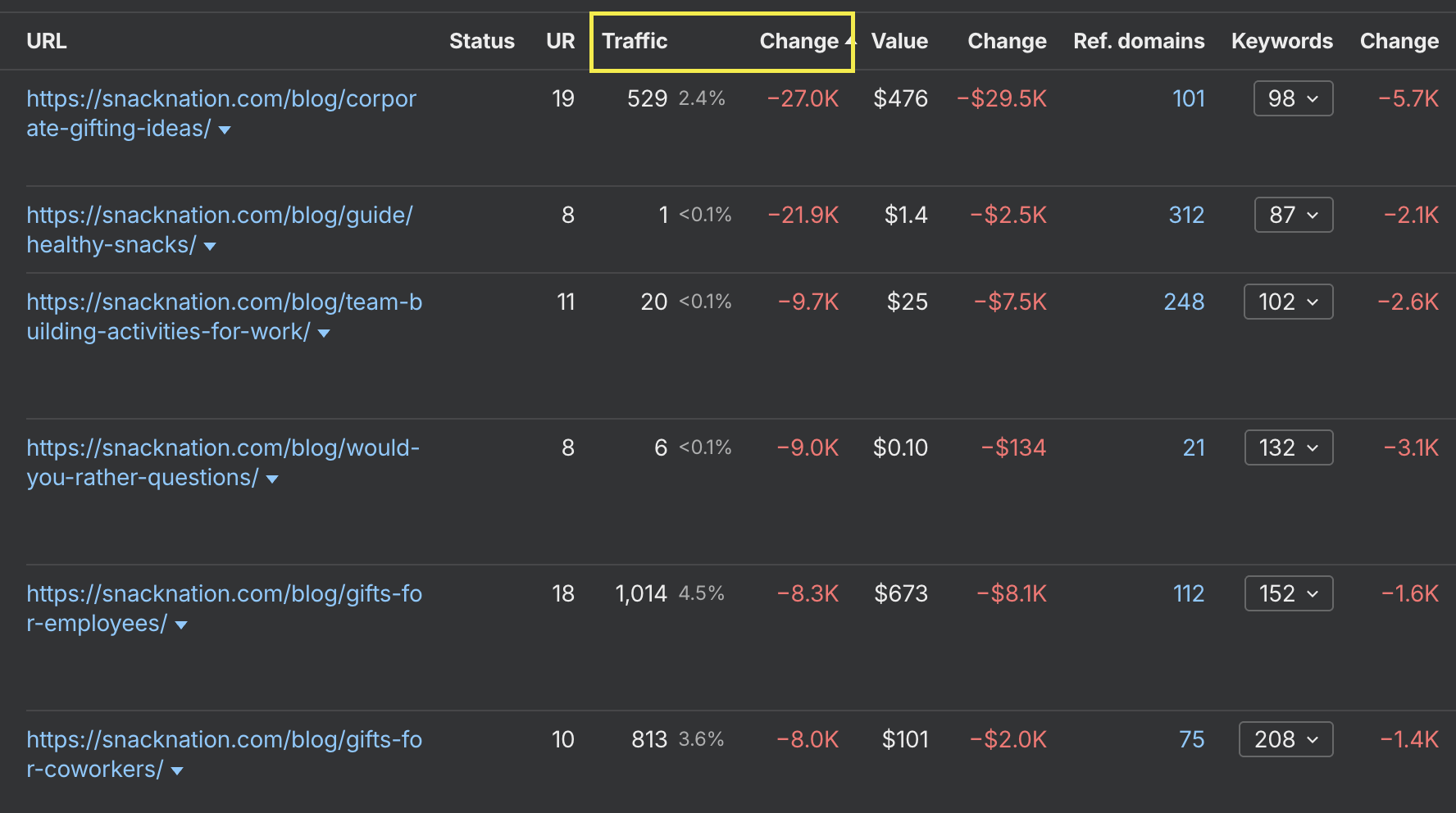
SEO tools like Ahrefs and SEMrush can help you identify URLs that have experienced decay, but those findings should always be corroborated with data with at least one of the other platforms. These tools have pretty good methods for estimating performance but at the end of the day, it is just an estimate and not actual data.
In Ahrefs, you can use the Top Pages report to see performance from two different time periods and quickly spot posts with decay in traffic and the number of keywords.
Additionally, you can see at an aggregate level for the entire domain, as well as URL-specific data on where you show up in AI Overviews, which helps you determine the reasons for decay.
Clearscope
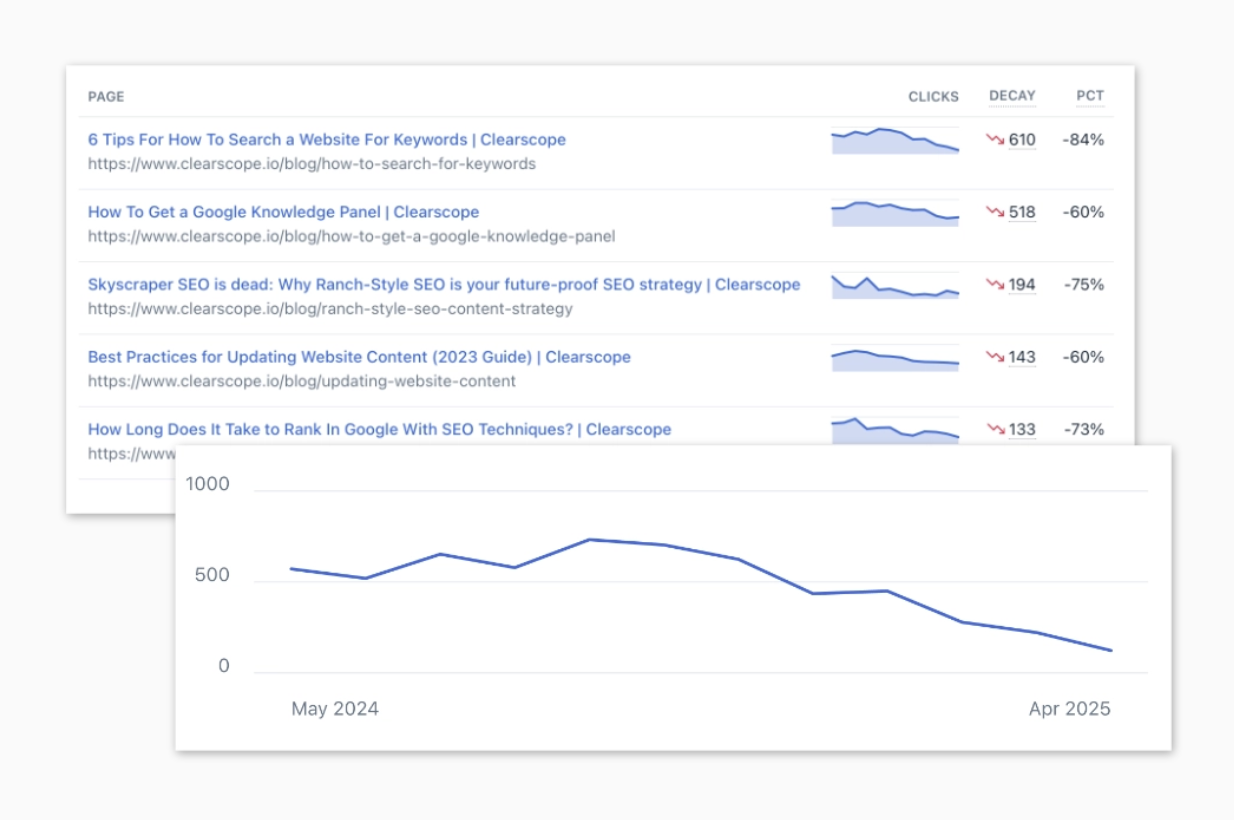
Clearscope offers a great functionality inside of their product called Content Inventory, which allows you to import specific URLs or every URL from your site to monitor and track performance over time. This can be helpful for teams because it works nicely with the tools they have to optimize and update the existing content that needs to be refreshed.
Schema.org
Schema validation tools are an easy way to check the status of your structured data (and what is being included in the structured data) to confirm that is accurate, up-to-date, and formatted correctly.
You can validate the schema for specific URLs with free tools like: https://validator.schema.org/
LLM visibility tools
Just as you can lose organic traffic from content decay, you can also lose referral traffic and LLM visibility from content decay, so it is only logical that your LLM visibility should be tracked moving forward.
There are a lot of tools on the market today, including some level of this available in tools mentioned above like Ahrefs, SEMrush, and Clearscope. However, tools like Gumshoe, Peec AI, PromptWatch, and Profound are specialized in LLM visibility tracking.
What to look for when investigating content decay
At the single URL level, there are a number of ways to spot existing decay as well as the early signs of content that is about to move out of the peak stage and into decay.
Sustained decline in traffic
The first is the content that has seen a steady and sustained decline in traffic. If you are looking back at least six months, you should be able to spot the pattern of less traffic pretty easily.
In URLs that have less volume, it may be harder to spot the decline with a trendline. In the cases where it is hard to visualize the downward trend, it can be helpful to compare two date ranges to each other to roll up and quantify the impact.
Traffic plateau
The interesting thing about plateaued traffic as a type of decayed content is that it is less obvious. It is easy to see the performance and think, “cool, this post drives x amount of traffic each month.” However, what you can’t see is that most often the post is missing out on more traffic and potentially continued growth.
As we noted before, the plateau can happen for a number of reasons. If the traffic has plateaued because you are hitting the natural limits of the topic and there isn’t more to capture, that’s a different story, but most of the time a plateau represents some level of uncaptured potential.
Impressions and # of keywords
In some cases, you may find that clicks/traffic are consistent or still growing but the impressions and number of keywords that the content ranks for are starting to decline.
This is usually a good leading indicator of content decay. It is typically the case that you still rank well for the core terms in the topic but some of the additional terms are starting to lose ranking and you aren’t getting the impressions.
The reason this can potentially matter is that it can be a signal that your topical depth is no longer sufficient or the search intent is starting to shift on the topic. Even if you are able to hold on to the majority of the core performance for a while, these should at the very least be put on some sort of watch list because change is happening and it will likely become a factor in the near future.
Decline in CTR
Even if you rank #1 for every single keyword that is relevant to the topic of a blog post, you could still technically see content decay if your click through rate is declining.
Search engines are constantly testing nuances of the design of the SERPs, which could impact your CTR. Or, maybe a competitor ranks below you but has a much more compelling title tag that is stealing clicks, even if they don’t outrank you.
Look for content that has seen a decline in CTR and then try to understand if that is from a drop in rankings or some other factor to know how to address it.
How to fix decaying content
Now that you have identified content on your site that is experiencing decay or may potentially begin to decay very soon, you can think about how to address the issues.
Here are the five most effective content optimization tactics to incorporate into your SEO strategy to fix your decaying content and renew the content life cycle for better organic performance.
Expand content
If your existing content is good but lacks topical depth, you can expand on the existing content to better cover all aspects of the topic and create a better resource for visitors. It might require the word count to increase by an extra 200 words or maybe 2,000.
Search for your core topic in Google and review the content of the sites that are ranking on the first page. Take note of the aspects of the topic that they cover but you don’t. Do some additional keyword research on those aspects and create a game plan for how to expand your content.
Keep in mind, if you are still ranking in the top 3, this doesn’t mean you don’t look at sites ranking below you because there is a good chance they are gaining ground on you and this process can help you uncover why.
Update content
Sometimes, a content refresh will entail modernizing the references, screenshots, statistics, and anything else that can feel dated.
Other times, content refreshes will entail restructuring the content, adding more/better headers, removing content, adding content, and more. The update can feel pretty lightweight or like a total overhaul and it all depends on how out of line it is from the content currently holding spots on the first page of Google. Updated content also presents an opportunity to re-promote the post on social media or include it in your marketing automation campaigns.
Recommended Reading: How to identify content update opportunities for your Q4 plan
Recommended Reading:How to update existing content to win back rankings and conversions [step-by-step instructions]
Consolidate content
In the cases where you have internal competition or a number of small content pieces that aren’t even ranking, it may be a good opportunity to consolidate your content and pull everything together into one significant piece of content.
There is some nuance as to whether you keep one piece as the main one and consolidate others into it or create a new one from scratch, taking from the existing content, and consolidate everything into the new piece.
An important aspect of content consolidation is setting up the correct 301 redirects from the old URLs to the new primary URL. This helps the search engines to see that you have moved the content and have multiple places that are now all redirecting to the main post, which shows that you intend for the main post to be the one they care about and index.
Recommended Reading: Content Consolidation: How to Reduce The Number of Articles on Site To Grow Organic Traffic
Create new content
In some cases, you will review the existing content and think, “oh man, we only have a few sentences on this part but it could totally be its own topic.” That is usually a great way to identify one or more new content ideas from the content that you already have.
In terms of how it addresses decay, this is a situation where you were likely getting some impressions and rankings for that topic at one point because you mentioned it, but now that others are covering it more fully, you are slipping in the SERPs and it doesn’t make sense to try to cover the topic fully inside of the existing content.
By creating the new content, you take the part that was decaying and give it a brand new place to achieve topical depth and recapture the decay PLUS much more growth through new keywords in that topic.
Get more backlinks & internal links
There are some cases where the content is still great, in-depth, up-to-date, and aligned with search intent, it just doesn’t have as many backlinks as some of the others competing in that SERP. Or, you are missing opportunities to point more internal links to that content from pages and posts that have been created since it was first published.
In this case, you may not have to do anything with the content itself, but can focus on creating some link building campaigns to generate backlinks to the content or build internal links.
Optimize for AI Understanding
AI systems extract information best from clear, declarative statements. Instead of writing "Content decay can be thought of as a situation where traffic might decline," write "Content decay occurs when organic traffic declines over time." This clarity helps AI systems confidently cite your content. Implement schema markup wherever possible. FAQ schema for Q&A sections, HowTo schema for tutorials, and Article schema for blog posts provide structured data that AI systems easily parse.
Create scannable sections with subheadings that directly answer user questions. Include explicit definitions for key concepts and explain relationships between ideas. Add "best answer" sections or summaries at the beginning of major topics to make your content more quotable for AI Overviews.
Optimize for E-E-A-T
AI systems place heavy weight on expertise signals when selecting content to cite. Ensure every piece has a detailed author bio with relevant credentials and specific topic expertise. If your author has 10 years managing SaaS content, state that explicitly rather than using generic bios.
Link to authoritative sources like research papers and industry studies throughout your content. Add expert quotes or cite primary data to support claims. Update older "about the author" sections with recent credentials. For technical topics, have a subject matter expert review the content to strengthen its authority signals for AI systems.
Format for LLM Consumption
Break long paragraphs into 2-3 sentence chunks that each convey one clear idea. Use descriptive headers that include the actual question, like "What Causes Content Decay?" rather than vague creative titles. Convert lists into bullet points and use tables for data comparisons. LLMs extract structured information more easily than prose.
Add TL;DR sections or "Key Takeaways" at the start or end of major sections. These formatting changes improve both AI visibility and user experience by making content scannable and digestible.
Common challenges with content decay
The challenges surrounding decaying content are not just limited to what happens in the SERPs. The processes your team follows, the expectations of your company, and the skill sets on your team (or not on your team) all compound the challenges of declining blog post performance.
The team focuses on new content only
We see a lot of companies that have all of their process and content marketing strategy built around creating 100% new content. Sometimes it is intentional, sometimes it is habit, and other times it is due to expectations of company leadership.
Being able to consistently address content decay and benefit from fixing it, companies need to shift their entire process and expectations to operate in a strategy that balances new content with updating old content, because it will keep happening.
It keeps happening
Content decay is not something that happens one time and as long as you fix it, you are good. The content stays on that same life cycle we shared and it will decay again.
In some cases where the topic is highly competitive, content can begin to decay in as little as 30-45 days. We have also been a part of updating some high impact blog posts that drove 100k visits and $3k in new MRR every month, but it required updates or modifications every ~60 days to prevent that from declining.
When you get to the point where you have hundreds or thousands of blog posts, this can become a significant operation.
Limited in-house expertise
As we walked through, it isn’t very hard to find individual blog posts or pages that have decayed in Google Analytics and/or Google Search Console. That should be well within reach of anyone with a basic understanding of those tools.
However, knowing how to diagnose why the content has decayed and then determine the right solution on a case-by-case basis requires a deeper understanding and more experience.
Hard to hire for
A lot of people can talk about refreshing content and SEO content at a high level, but there are far fewer that have actually done it consistently, at scale, with a proven track record. Not to mention, those folks are typically much more expensive and already in good roles, so for 99% of companies, this is a skill set that’s difficult to acquire.
Content decay in the age of answer engines
The search landscape has fundamentally fragmented beyond Google. Users now get answers from Perplexity, ChatGPT, Claude, Gemini, and dozens of other AI-powered answer engines, each with different source selection criteria and citation practices. Your content must now serve multiple interfaces simultaneously, and tracking decay has become exponentially more complex.
A blog post might maintain strong visibility in traditional Google results while being completely absent from ChatGPT Search citations or Perplexity answers. This fragmentation means content can experience partial decay across platforms, making it harder to diagnose problems and measure true visibility.
Link building has become even more critical in this new ecosystem because AI systems heavily weight backlinks as authority signals when selecting sources to cite. However, the goal has shifted from just building links for PageRank to becoming a frequently referenced authority that AI systems learn to trust and cite consistently.
The challenge for content teams is that optimizing for one answer engine doesn't guarantee visibility in others, requiring a broader, more adaptable approach to content maintenance and decay prevention.
Are you experiencing content decay?
Content decay is a real problem that affects every website with content, whether they realize it or not.
If you are unsure of the extent of decay impacting your performance or have identified it but don’t know how to address it, we’d love to chat with you.


Discover how we can help
Book a call with us and we’ll learn all about your company and goals.
If there’s a fit, we will put together a proposal for you that highlights your opportunity and includes our strategic recommendations.