

AI is how most good content teams produce content now. We use it every day at Ten Speed, and it does the bulk of our production work. It doesn't run on its own, though. A team of strategists, specialists, and editors runs every workflow and reviews every output along the way.
So whether to use AI for content creation isn't really the question anymore. The question is where it does the work, where people stay involved, and who builds the system that ties it all together.
This guide walks through how we use AI at each stage of content creation, which content should start with AI vs. a person, what AI still gets wrong in editing, and the (short) list of tools we actually use.
Key takeaways
- AI does most of the production work, but experts run it. Strategists, specialists, and editors each own their part of the process and review every output.
- The type of content decides the mix. Briefs and refreshes can start with AI. Authority content and guides should start with a person.
- Editing is still a hybrid step. Editors use AI to catch consistency problems, then catch what AI misses: Made-up facts, generic phrasing, and a missing point of view.
- The tools aren't the advantage. How the workflows are built, who runs them, and how often they're re-tuned is.
- For most B2B teams, partnering with an agency that does this every day gets better results faster than building it in-house.
What AI content creation actually means for B2B teams
AI content creation is using AI tools to handle parts of the content process, like research, briefs, drafts, editing, and optimization. For B2B teams, that usually means AI does the heavy lifting on production, and people own the strategy, the subject matter expertise, and the final call on what gets published.
The teams getting real results treat it as a system (inputs, workflows, editing, QA), not a button that spits out blog posts. And the people running that system still do the critical thinking. Strategy comes from client calls, product knowledge, sales insights, and real collaboration with the client's team, not from a prompt.
AI does the work, experts run it
Every AI workflow on our team has an owner, and that owner is an expert in that part of the job. We don't hand the tools to whoever's free and hope for the best.
- Strategists run the strategy workflows: Topic selection, roadmaps, and AI visibility tracking. They also bring the client context (goals, product, positioning, what sales is hearing) that no tool has.
- Specialists run the research and content production workflows: SERP research, briefs, AI-first drafts, optimization, and refreshes.
- Writers draft human-first content like authority pieces and guides.
- Editors run all of the AI-assisted editing and do the human QA on every piece before it goes to the client.
Each person reviews what AI produces at their stage before it moves to the next one. That's how AI speeds up the work without anything slipping through.
How to use AI for content creation, stage by stage
AI can help at every stage of the content workflow, but it does a different job at each one. Here's how it breaks down for us.
| Stage | What AI does | What people own | Who runs it | Tools we use |
|---|---|---|---|---|
| Strategy and topic selection | Pulls keyword, SERP, and AI visibility data, finds gaps | Picking topics that tie back to client goals and the buyer | Strategists | Ahrefs, Peec AI, Claude |
| Research and briefs | Summarizes what's ranking and getting cited, builds the outline and internal link recs | The angle and what makes this piece different | Specialists | AirOps, Clearscope, Ahrefs |
| Drafting | Writes the first draft from the brief and source material | The source material (SME input, product details, data) | Specialists (AI-first), writers (human-first) | AirOps, Claude |
| Editing | Checks against the brief and brand voice, cleans up, flags issues | Facts, POV, and the final call | Editors | AirOps, Claude |
| Optimizing for search and AI answers | Checks topic coverage, structure, and AI visibility | Deciding what matters and what's noise | Specialists and strategists | Clearscope, Ahrefs, Peec AI |
| Refreshing | Flags stale content and drafts updates | Which pieces are worth refreshing | Strategists decide, specialists update | AirOps, Ahrefs, Peec AI |
Strategy and topic selection
AI handles the grunt work here: Pulling keyword data, seeing which prompts and sources show up in AI answers, and spotting what competitors cover that you don't. It's not great at knowing which topics actually matter to your business, though. Our strategists make that call, based on what they know from working with the client: Goals, product, positioning, and what's coming up in sales conversations.
Research and briefs
A good brief is most of the battle with AI content. If the brief is thin, the draft will be too. Our specialists run the research and brief workflows, using AI to build briefs fast and Clearscope to make sure we're covering what the topic needs. The strategist still sets the angle (i.e., what we're saying that nobody else is).
Drafting
This is where AI does the most work. Specialists run the drafting workflows for AI-first content, and a writer drafts anything human-first. Either way, the quality of the draft comes down to what you feed it: The brief, brand guidelines, SME notes, product details, and real data. Garbage in, garbage out still applies.
Editing
Still a hybrid step, and probably the most important one. We go deep on it in the editing section below.
Optimizing for search and AI answers
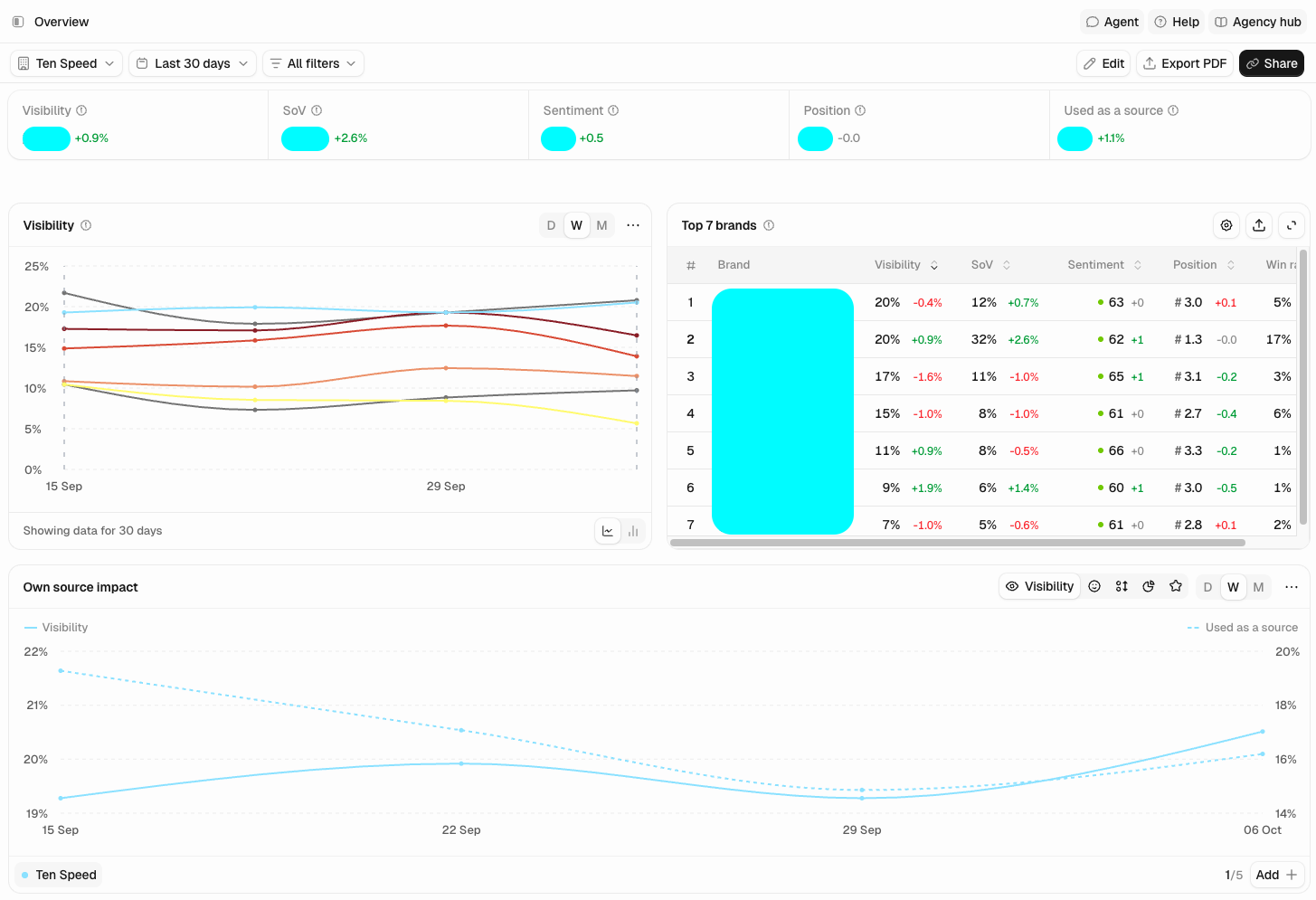
Specialists check topic coverage in Clearscope and structure every piece so it's easy for Google and LLMs to pull answers from (answer-first sections, clear headings, FAQs, key takeaways). Strategists use Peec AI to track how often the client shows up in ChatGPT, Perplexity, and Google's AI answers, which sources those answers cite, and where competitors show up instead. That tells us what to create next and what to fix. For more on the search side, see our guide to SEO content.
Refreshing existing content
AI makes it a lot easier to keep existing content up to date. It can flag what's stale and draft the updates. Strategists decide what's worth the effort (often based on where a client is losing ground in AI answers), and specialists handle the updates. Freshness matters even more in AI search, so this can't be an afterthought anymore (more on that here).
Keeping it organized
None of this works if nobody knows where a piece stands. We run every piece through ClickUp so strategists, specialists, editors, and clients all see the same status.
AI-first vs. human-first: Match the workflow to the content
Not every piece of content should start with AI. The more a piece depends on first-hand expertise, the earlier a person needs to be involved. We run two versions of our content process depending on what we're making.
The AI-first lifecycle
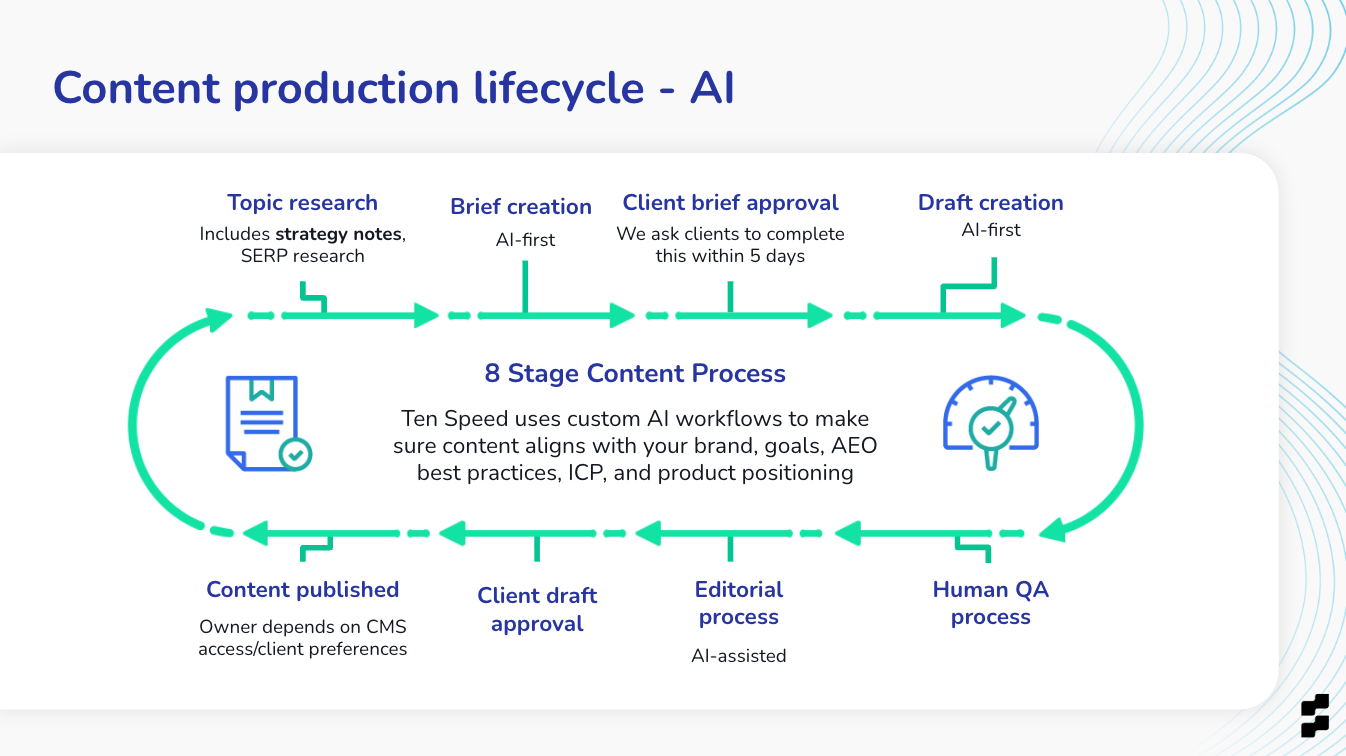
- Topic research (strategy notes, SERP research)
- Brief creation (AI-first)
- Brief review and approval
- Draft creation (AI-first)
- Editorial pass (AI-assisted)
- Human QA
- Draft review and approval
- Publish
This works best for blog posts, refreshes, and other content where the expertise can be captured in the brief and the source material.
The human-first lifecycle
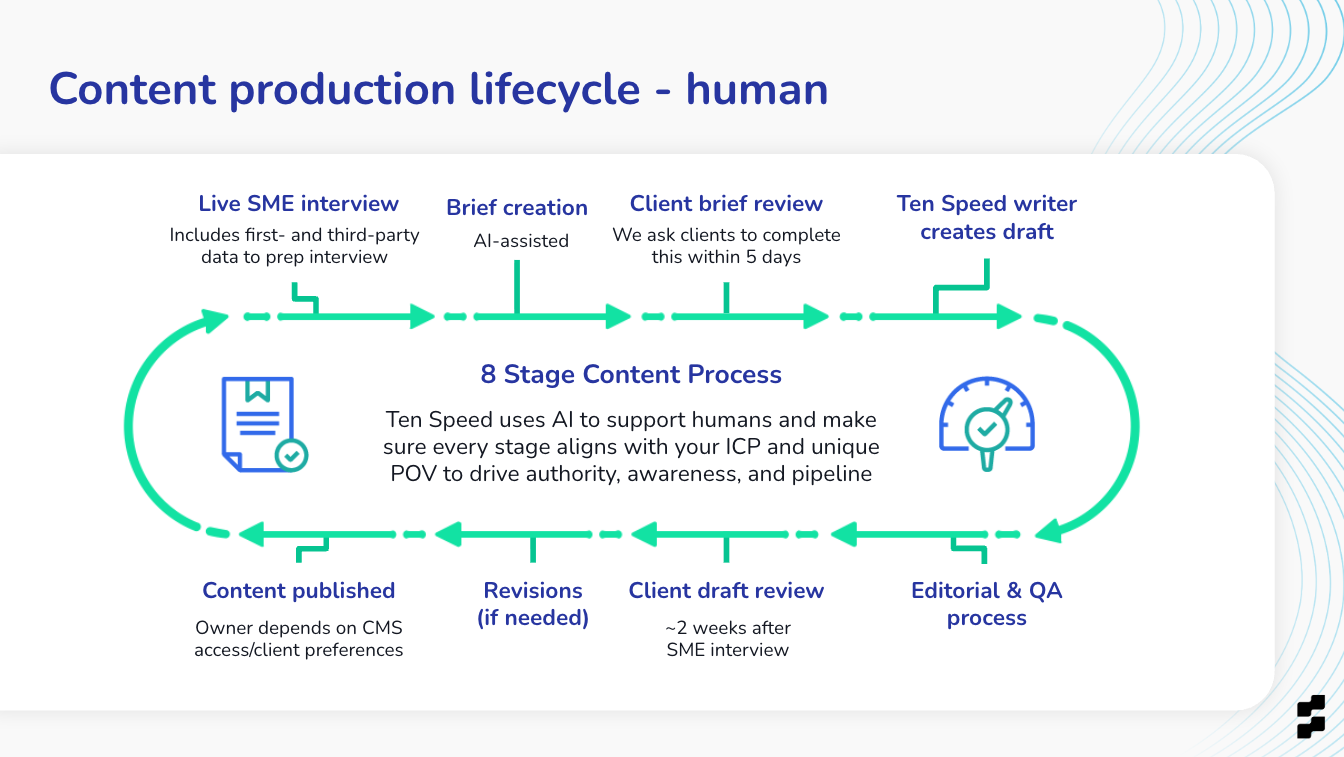
- Live SME interview (prepped with first- and third-party data)
- Brief creation
- Brief review
- Writer creates the draft
- Editorial and QA (AI-assisted)
- Draft review
- Revisions
- Publish
This works best for authority content, guides, and anything where a real expert's point of view is the whole point.
AI shows up in both. Even our fully human-written content goes through an AI-assisted edit.
Which content gets which approach
| Content type | Starting point | What AI does | What people do |
|---|---|---|---|
| AEO refresh | AI-first | Formatting, FAQs, key takeaways | QA before it goes live |
| Content brief | AI-first | Research, outline, internal link recs | Set the angle and approve |
| SEO/AEO blog post | Human + AI | Drafts from the brief | Edit, fact-check, add POV |
| Press release | Human + AI | First draft | Accuracy, messaging, approvals |
| Core website page | Human + AI | First draft | Positioning and multiple revision rounds |
| Case study | Live interview, then human + AI | Drafts from the interview | Run the interview and shape the story |
| Authority content | Live SME interview, human-written | Interview prep and editing support | Write it |
| Guide or ebook | Live SME interview, human-written | Interview prep and editing support | Write it |
AI content editing: Where AI helps and where it falls short
Editing is still a hybrid step, and it's where most AI content either gets good or doesn't. AI makes editing faster and more consistent. It also gets specific things wrong that a person has to catch.
Editing is two layers
Every piece we produce gets an AI-assisted editorial pass and then a human QA pass (you can see both in the lifecycles above). Our editors own both. They run the AI-assisted pass to handle the cleanup, then do a thorough human review of the stuff that decides whether a piece is actually worth reading.
What AI does well in editing
- Checking the draft against the brief (did it answer the questions it was supposed to?)
- Checking against brand voice and style guidelines
- Cutting repetition, filler, and rambling intros
- Tightening structure and headings
- Flagging claims that need a source
- Spotting gaps compared to what's ranking and getting cited
- Keeping quality consistent when you're publishing a lot of content
What AI gets wrong
AI is confident about everything, including the stuff it gets wrong. A made-up stat reads exactly like a real one. These are the problems our editors catch most often.
| Problem | What it looks like |
|---|---|
| Made-up stats and sources | A specific number with a source that doesn't exist (or doesn't say that) |
| Generic phrasing | “In today's fast-paced landscape,” “delve,” “game-changer,” and dashes everywhere |
| Everything sounds the same | The same structure, intros, and transitions across every piece |
| Sanded-off opinions | A strong take turns into “it depends” and “both have pros and cons” |
| Invented examples | A customer story or scenario that never happened |
| Missing technical nuance | A technical B2B topic simplified until it's wrong |
| Doesn't know your product | Describes features you don't have, or positions you like a competitor |
| Over-editing | “Fixes” the expert's point until it isn't their point anymore |
What a human editor still owns
- Fact-checking every stat, quote, and claim against a real source
- Adding SME input and first-hand experience that AI doesn't have
- Protecting the point of view (keeping the strong take strong)
- Making sure it's accurate to the product and the market
- The final call on what ships
Using AI to edit AI
Our editors also use AI to check AI. Review passes catch common AI writing patterns and flag likely problems before an editor does the full read. That way our editors spend their time on substance (facts, POV, accuracy) instead of cleanup.
The AI content creation tools we actually use
Our stack is short on purpose. We'd rather go deep on a few tools than juggle 40 of them. And every tool sits with the people who know that part of the work best.
| Tool | What we use it for | Who uses it | Why we use it |
|---|---|---|---|
| AirOps | Most of our production: Briefs, drafts, refreshes, editing passes | Strategists, specialists, and editors, each running the workflows for their stage | Lets us build custom workflows and keep tuning them |
| Claude | Research synthesis, drafting support, editing passes | The whole team | The strongest writer and editor of the models we've tested |
| Ahrefs | Keyword research, SERP and competitor analysis | Strategists and specialists | The data we trust most for deciding what to write |
| Peec AI | Tracking AI visibility, prompts, and citations | Strategists | Shows where clients show up (and don't) in AI answers, and who gets cited instead |
| Clearscope | Topic coverage in briefs and drafts | Specialists | Keeps coverage tight without keyword stuffing |
Why the tools aren't the advantage (the workflows are)
Anyone can buy AirOps or a Claude subscription. Two teams with the exact same tools can still get completely different results.
The difference is in how the workflows are built. That includes what you feed them (brand guidelines, SME input, product details, first-party data), how each step is set up, and where the quality checks sit. We cover more of the thinking behind this in our post on building an AI content marketing engine.
The workflows also can't sit still:
- Models change every few months. A workflow that worked great in the spring can start producing worse output by the fall. It has to be re-tested and re-tuned constantly.
- What “good” means keeps changing too. AI search changed what gets cited, and the workflows have to keep up with that.
- Results should drive the changes. The best workflows get tuned based on what actually performs (rankings, citations, pipeline), not set up once and left alone.
And without a strategy behind it, more AI-generated content usually just means more content that doesn't perform.
AI content agency vs. building in-house
For most B2B teams, partnering with an AI content agency gets better results faster than building it yourself. Not always, but most of the time.
The obvious reasons
- You don't have to hire writers, editors, and someone to build and maintain workflows.
- There's no ramp-up time or tool setup to sort out.
- You skip the learning curve on workflow design and start with a system that already works.
- You can scale volume up or down without hiring or layoffs.
The bigger reason: This is all we do
Agencies like ours are specialized in this, and honestly a little obsessed with getting it right. For an in-house team, AI content is one project on a long list. For us, it's the job.
- Every part of the work has a dedicated expert running the AI workflows for that stage (strategists, specialists, editors). That's hard to staff in-house, where one person often ends up prompting everything.
- We run these workflows across a lot of content programs and industries, so we see what breaks (and what works) much faster than a single team can.
- When a new model drops or AI search changes what gets cited, re-tuning the workflows is our job that week, not a backlog item for next quarter.
- We see what gets cited across a whole portfolio of clients, and every client benefits from those patterns.
| Build in-house | Partner with an agency | |
|---|---|---|
| Time to launch | Slower: Hiring, tool setup, building workflows | Faster: The system already exists |
| Upfront cost | Salaries, tool licenses, build time | A monthly retainer |
| Workflow expertise | Built from scratch | Built and tested across many programs |
| Keeping up with model changes | Depends on bandwidth | Part of the job |
| Learnings across industries | Limited to your own program | Patterns from a whole portfolio |
| Scaling up or down | Hiring or layoffs | Adjust the scope |
| Access to SMEs and product knowledge | Easier, since they're down the hall | Needs a good process |
| Control over voice and approvals | Full control | Shared, with clear approval steps |
When in-house makes sense
Building it yourself can be the right call if you have:
- Very high volume and a long-term budget for content operations
- Deep internal SMEs who need to be involved in every piece
- Heavily regulated content with a tight internal review process
The hybrid that usually works best
For most teams, the best setup is a split. The agency builds and runs the engine. Your team brings SME input, product knowledge, and final approval.
If you're evaluating an AI content agency, look for one that:
- Can clearly explain where AI is used and where people are involved
- Has dedicated experts running each part of the process (strategy, production, editing), not one person prompting everything
- Puts real editors on every piece (not just a proofread)
- Builds custom workflows around your brand instead of a generic template
- Has a plan for keeping workflows current as models change
- Reports on pipeline and AI visibility, not just how much content shipped
- Treats your SMEs as a key input, not an optional one
We talked through a lot of this on Session #9 of our podcast, What AI Means for Content Teams in 2026, including how teams split work across writers, editors, strategists, and agencies.
Skip the build. Get the engine.
We build custom AI workflows, keep them tuned as models change, and put real editors on every piece. You bring the expertise. We handle the rest.
Let's chatYou can see more about how we run content programs on our content creation page.
How to make AI-assisted content get cited in AI search
AI-assisted content can absolutely get cited in ChatGPT, Perplexity, and Google's AI answers. It just has to be built for it.
- Answer first. Put a direct answer at the top of each section, then expand on it.
- Make it easy to pull from. Use descriptive headings, short sections, tables, key takeaways, and FAQs.
- Add something new. Original data, first-hand experience, and a real point of view. LLMs have already seen the generic version of every topic.
- Keep it fresh. Update important content on a regular schedule, not just when traffic drops.
- Build signals off your site too. Mentions, reviews, and citations on other sites all feed into what AI answers say about you.
- Track it. Use an AI-visibility tool like Peec AI to see which prompts you show up for, which sources get cited, and where competitors win instead. Then use that to decide what to create or refresh.
This is a big part of how we approach AEO for clients, and why AI-assisted content and AEO really can't be planned separately anymore.
Frequently asked questions
Can AI create original content?
Not on its own. AI predicts patterns from what it was trained on, so without new inputs (SME interviews, first-party data, a real POV), it mostly remixes what already exists. With those inputs, AI can help you produce original content a lot faster.
Can AI edit content?
Yes, and it's good at a lot of it (consistency, structure, cutting filler, flagging claims that need a source). It still misses made-up facts, generic phrasing, and technical nuance, so every piece needs a human editor before it ships.
How do you edit AI-generated content?
Start with an AI-assisted pass for cleanup and consistency. Then have a human editor fact-check every claim, cut generic phrasing, add SME input and real examples, and protect the point of view. Check it against the brief one more time before you publish.
Will AI replace content writers?
It's changing the job more than replacing it. Writers and editors who can direct AI, add real expertise, and edit hard are more valuable now. The parts of writing that are pure production are the parts AI is taking over.
Is AI content bad for SEO?
No. Google cares about whether content is helpful, not how it was made. Low-effort content that adds nothing new is the problem, and that's true whether a person or AI wrote it.
What's the best AI for content creation?
For us, it's Claude for writing and editing, AirOps for running production at scale, Ahrefs for research, Clearscope for optimization, and Peec AI for tracking AI visibility. But the tools only work as well as the people running them. How well your workflows are built, and who owns them, matters more than which model you pick.


